Last month the CNI blog surpassed 1000 blog posts. When I think about what else there is to write about survival and preparedness, I find that everything has pretty much been said. So I considered what to do with the blog once everything has been said and figured I could either mothball the thing or start over.
Since I am still interested in preparedness, albeit less active in official disaster planning and preparedness than I was back when I started the blog, I decided that instead of letting the blog just sit, I would start over.
Beginning in September, I will start (actually continue) blogging here as if I were starting at the beginning with a new blog. It may seem redundant to long-time readers who have heard--ad nauseum--about bug out bags and communication plans, et al, but I figure there are always people coming up who are just starting with preparedness and disaster planning so the basic information could prove useful to them.
Onward!
Sunday, August 25, 2013


Monday, August 5, 2013
Some Things You Should Know About Technology
Even if you aren't a died-in-the-wool tech geek, you should have at least a bit of knowledge about current technology (ie: what you don't know could hurt you):
- Top 10 Reasons to be Afraid of Hackers
- 'Smart Homes' are Vulnerable
- Your TV Might be Watching You
- Think Twice About that Burner Phone
- Feds Suspected in Malware Attack
- US Covers Up Program that Tracks Americans
tldr; although you don't need to be a tech genius (and with the exponential growth of the field, this would be nearly impossible anyway) but you do need to be aware of how hackers--and the government--can use technology to your detriment.
Saturday, August 3, 2013
Summer Hiking in the Desert
I'm pretty much a year-round hiker. This isn't a problem in the Pacific Northwest (unless you have something against walking in the rain...year-round), but hiking in the summer in the desert southwest is a whole other matter.
Unfortunately, many tourists are lured to the amazing vistas in the desert southwest, yet they want to see these sights during their summer vacation. It's hot as Hades in the desert in summer. Which leads to deaths (examples here, here, and here). But it isn't impossible to enjoy the outdoors during the summer in the desert if you take a few precautions:
Unfortunately, many tourists are lured to the amazing vistas in the desert southwest, yet they want to see these sights during their summer vacation. It's hot as Hades in the desert in summer. Which leads to deaths (examples here, here, and here). But it isn't impossible to enjoy the outdoors during the summer in the desert if you take a few precautions:
- Pay attention to high heat warnings. Believe it or not, there is a difference between 100 degree temps and 115 degree temps. Don't hike during times of high heat warnings (unfortunate example here).
- Plan short, early hikes instead of lengthy, all-day hikes. I'm at the trail head at daybreak, hike five to ten miles, and am back to my vehicle by 9am.
- Carry twice as much water as you think you will need and drink often. You can become dehydrated and not even know it until you feel like you've been hit by a Mack truck. Drinking water (not coffee, not alcohol) frequently can alleviate this problem. I also carry extra water to give away as I've run into other people on the trail before who didn't bring enough water.
- Dress appropriately. Shorts and a tank top may be fashionable but it is a bad idea to wear clothing that doesn't protect you from the sun. Long pants (which not only protect your from the sun but can protect you from bugs and random cactus encounters), lightweight-long-sleeve shirts, a hat, and appropriate boots are also necessary.
- Don't forget sunscreen, and reapply liberally, as well as sunglasses.
- Bring some sort of food as well (even if you don't usually eat early in the morning, you need to fuel your body for the hike so eat something before you head out and bring additional food with you).
- If you don't know where you are going, go with a guide. Or at least use appropriate technology to ensure you can find your way back to your start point.
- Hike with someone, if possible, and also email your itinerary to a trusted friend (so if you don't come back they will know where to begin searching for you).
- Be aware of desert dangers (usually snakes, possibly Gila monsters, and even goats). And flash floods. Don't hike in desert areas where it recently rained, is currently raining, or expected to rain.
- Bring your emergency kit with you (include compass, emergency blanket, matches, etc). Example here.
- Other gear to bring: a day pack, hiking poles, a cell phone, GPS device, etc.
- Study up on the topic of desert hiking. Or better yet, take a class if possible. There is a lot to learn about hiking and surviving in the desert and it's better to learn from other's (not your own) mistakes. A good basic primer can be found here.
Friday, August 2, 2013
From the "World is Going to Hell in a Handbasket" File
Some examples...
- 4 in 5 in US face near poverty
- Dozens of CIA operatives were on the ground during Benghazi attack
- The US is closing it's embassies because of an 'unspecified threat'
- And then there is the Bradley Manning situation...
- ...Followed by the Russia/Snowden situation
- And there is, well, most everything you find on this subreddit
Thursday, July 25, 2013
The Wireless Emergency Alert System
A bit of an update on the last post...
During the storms we had a couple days ago, I noticed my cell phone (and everyone else's cell phones) would go off occasionally with emergency warnings. I thought it was a bit odd as while I do get some updates which I specifically signed up for (Nixle, CNN breaking news, etc), these messages seemed to come from out of the blue. A day later, our local newspaper ran a story about these alerts. Seems they come from a newish system called the Wireless Emergency Alert System. Read more about it here. Mystery solved.
During the storms we had a couple days ago, I noticed my cell phone (and everyone else's cell phones) would go off occasionally with emergency warnings. I thought it was a bit odd as while I do get some updates which I specifically signed up for (Nixle, CNN breaking news, etc), these messages seemed to come from out of the blue. A day later, our local newspaper ran a story about these alerts. Seems they come from a newish system called the Wireless Emergency Alert System. Read more about it here. Mystery solved.
Monday, July 22, 2013
It's Monsoon Season in the Desert
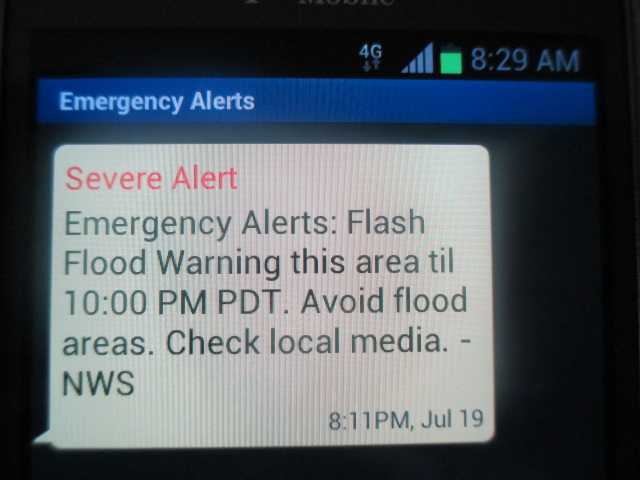
While living in the desert means we may only get six days of rain a year, all of the rain seems to come at once. This has been the case over the past few days. Wind, rain, thunder, lightening...all made an appearance over the past few days and in some areas (fortunately not where we live) that led to flash floods. Here's some precautions to take when in the desert during monsoon season (aka summer):
- If it is raining, try to stay indoors. Floods can form very quickly. You may be walking down a dry street one minute and see a river of water coming at you the next.
- If it is raining, try not to drive in low-lying areas and certainly don't drive on flooded streets (you don't know if the street below the water has been washed away or not).
- Don't play in the wash! Each season the washes fill up with water and look like fun places to play. Each season people drown from playing or swimming in the wash because the fast moving water sweeps them down the channel and drowns them under the debris. Sad.
- Pay attention to the news. If there is rain predicted, you can guarantee it will be a big deal on the news (not so much in Seattle, but in the desert it is a whole different story). There will be newscasts warning about potential flooding and a weather alert will flash across your regular TV programs to alert you as well.
- Something new: this is the first time I have received an unsolicited weather-alert on my cell phone (see photo above) and it seemed like the alert was pinged off of the local towers because everyone in the poker room a couple days ago received the same alert.
- Prepare your home for a storm just like you would do anywhere else. If you know it will be windy and stormy, bring in (or tie down) the lawn furniture, lawn ornaments, deck chairs, garbage cans, etc. so they won't fly down the road.
- Cut down dead or dying trees before storm season begins. Some people didn't do this.
- If the weatherman says there will be a storm, postpone your outdoor activities (like hiking or golf). Lightening is nothing to mess with.
- If you live in an area that is prone to flooding, take precautions ahead of time (like sandbagging, finding out where the closest shelter is that you can evacuate to, having your BOB ready to go at a moment's notice, etc).
- These storms can also cut your electricity for either a short or long time; prepare accordingly.
- Unplug your sensitive appliances (like TVs and computers) during an electrical storm.
These are basic, common sense rules which can often be forgotten in the middle of an exciting storm. Yes, the water looks pretty, but yes, the force of less than a foot of fast moving water can knock you off your feet and carry you away. Ditto for your car.
Sunday, July 21, 2013
10 Things You Should Know
Everyone once in a while I think to myself "I wonder if my readers know this?" Here's a list of things you should know:
- More on Michael Hastings (the conspiracy continues).
- Does your city/town/county/state have any useful discounts for you? A bit of Googling around saves me the cost of most of my annual vehicle registration fees just by taking advantage of this program. Your area may have similar discounts (for veterans, seniors, low income, et al).
- I posted this link on the Daily Insight links page but it is so important that I am posting it here as well. Tldr; don't let a lack of money stop you from doing amazing things (like reaching your goals, setting off on an adventure, etc).
- When you are buying things, always: search for discounts or coupons on the item, compare prices, check the discount bins, do price matching (example here), see if the product can be found at the Goodwill first (or online at Freecycle, Craigslist, etc).
- I have the cheapest cell phone plan of anyone I know. It's the $30 plan from TMobile at Walmart. Needless to say, I don't talk on the phone much but do send a massive amount of texts and use the internet quite a bit as well.
- Do you know about Kayak Explore? I use this site to find super cheap fares to various places that we travel to (note that we often hop from place to place so I find a cheap fare, check the dates, then go on Travelocity and look up the one way fare on the sale date and can often get pretty cheap fares to our destinations.
- This has absolutely nothing to do with preparedness except maybe the idea that you are only as old as you think you are and you need to "use it or lose it" and this woman obviously uses it quite often.
- In a couple weeks you will find me here.
- As I've pointed out before, the police are tracking you. Here's how.
- Where you won't find me is here (although I did give it a shot).
Subscribe to:
Posts (Atom)